Overview of the 0ktapus phishing campaign
The 0ktapus phishing campaign is a large-scale identity-focused attack that targets organizations using Okta for Single Sign-On (SSO). By leveraging highly convincing lookalike Okta login pages, attackers harvest credentials and MFA codes in real time, enabling unauthorized access to SaaS environments without triggering additional authentication challenges.
This campaign, widely attributed to the threat group Scattered Spider (UNC3944), has impacted more than 130 organizations globally and highlights how modern cloud environments remain vulnerable when identity is treated as an implicit trust boundary.
Once access is established, attackers can move laterally across federated applications, leading to widespread data exposure and operational risk.
Technical analysis: How 0ktapus bypasses Okta MFA
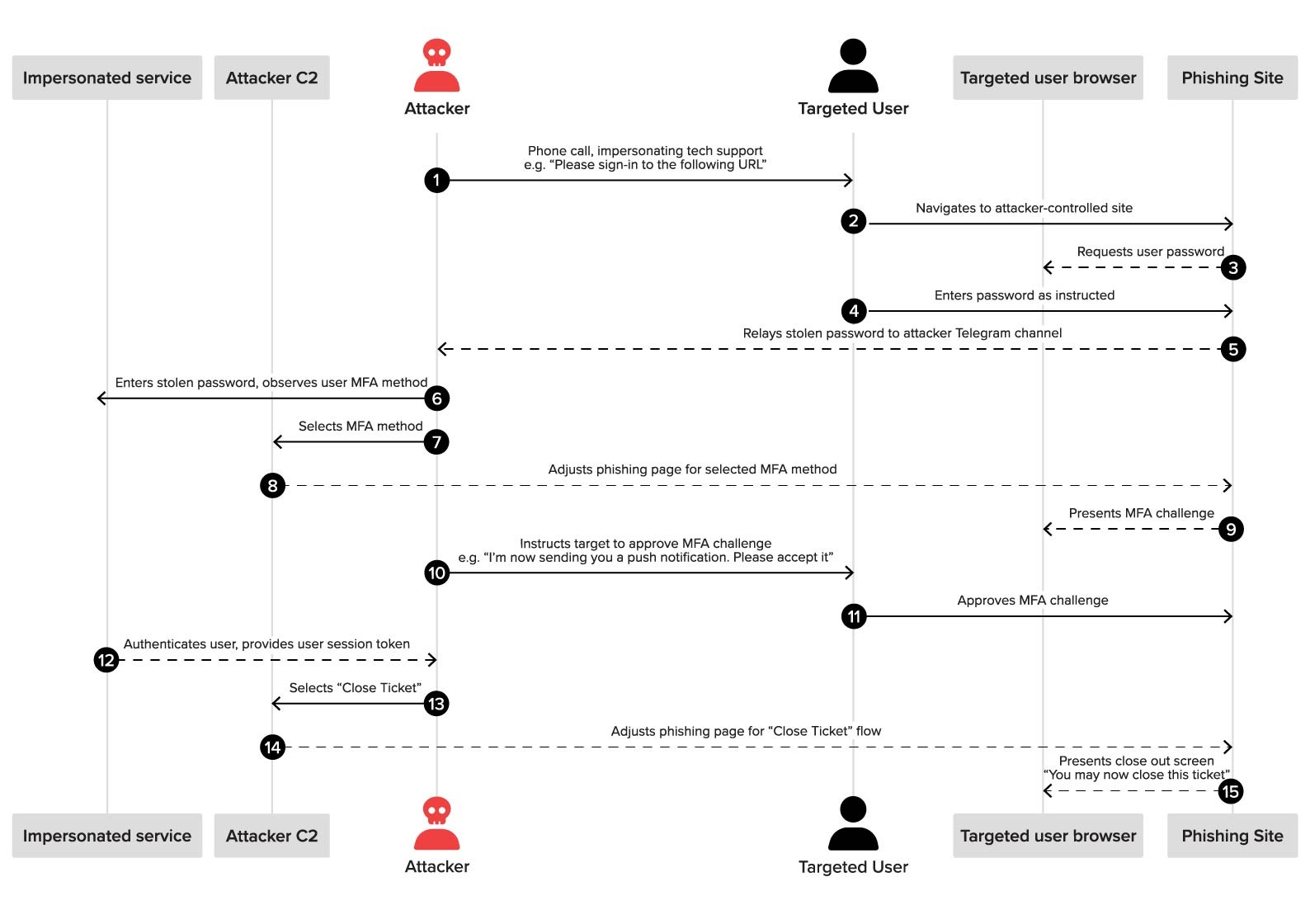
Attackers deploy lookalike Okta login pages that closely resemble customer-specific Identity Provider URLs. Victims unknowingly submit usernames, passwords, and MFA codes directly to attacker-controlled infrastructure.
Captured credentials are replayed against real Okta tenants to establish valid SSO sessions. Once established, attackers gain access to SaaS applications without triggering additional authentication challenges.
Tactics,techniques, and procedures (TTPs)
- Credential phishing
- SMS phishing (smishing)
- MFA fatigue
- Social engineering
- Federated SSO abuse
Platform(s)/vendor(s)
Primary Vendor:
- Okta
Adjacent vendors:
- Salesforce
- Microsoft 365
- Google Workspace
- AWS
Initial access
Attackers typically deliver malicious links via SMS and phishing campaigns. These operations are often high-volume, relying on scale to increase success rates.
To improve engagement, attackers use common marketing techniques such as urgency, authority, and scarcity. Domains are registered with keywords like “SSO,” “0kta,” and company names to increase legitimacy.
The text message may look highly convincing due to attackers registering a domain with a number of keywords such as: SSO-, Companyname-SSO, 0kta-, Companyname-0kta aimed at increasing the legitmiacy of the campaigns launched.
Campaign sophistication varies. Some phishing sites are static and collect credentials without interaction. More advanced variants dynamically redirect victims in real time based on their stage in the compromise process.
Business risk and impact
The impact of 0ktapus campaigns is severe. Organizations may lose control of IdP permissions, MFA tokens, and authenticated SSO sessions.
Once access is established, attackers can compromise entire SaaS ecosystems connected to Okta. This includes confidential data exposure, administrative access, data exfiltration, and lateral movement across cloud services.
Mitigation strategies
0ktapus campaigns demonstrate how effective social engineering and identity abuse can undermine mature authentication controls.
Many commonly deployed mitigations introduce friction, rely on detection, or are reactive by design. While none of these controls are foolproof in isolation, applied together they can significantly reduce attacker success, limit dwell time, and contain the scope of compromise.
Phishing-resistant MFA (FIDO2 / WebAuthn)
Phishing-resistant MFA significantly raises the bar for attackers, but it introduces usability challenges and adoption hurdles. Fallback authentication paths may weaken protection, and compromised endpoints can still undermine the control.
Even with these limitations, phishing-resistant MFA remains one of the strongest defenses against credential-based attacks. When broadly adopted and properly enforced, it can eliminate entire classes of phishing techniques used in 0ktapus campaigns.
Domain monitoring and takedown
Domain takedowns are reactive and often delayed. Organizations are dependent on registrars and hosting providers, and attackers routinely cycle domains to stay ahead of enforcement. False positives can also disrupt legitimate services.
Despite these challenges, domain monitoring reduces attacker dwell time. Faster identification and takedown of malicious domains can limit campaign scale and reduce the number of victims exposed.
Conditional access policies
Conditional access controls can be complex to configure and introduce user friction. Token reuse beyond evaluation points remains a challenge, and coverage is incomplete without continuous access evaluation (CAE).
When implemented correctly, conditional access policies add meaningful friction for attackers. They restrict access based on risk, location, posture, and behavior, which limits when stolen credentials can be successfully used.
Session revocation on credential compromise
Session revocation is inherently reactive and depends on detection speed. Token invalidation may be inconsistent across platforms, and aggressive revocation can cause operational disruption.
Even so, session revocation is a critical containment mechanism. When triggered quickly, it can cut off attacker access, prevent lateral movement, and limit the duration of a compromise.
User awareness training
Training alone rarely changes behavior consistently. User fatigue sets in quickly, effectiveness varies widely, and there is no technical enforcement component.
That said, user awareness remains an important control. When paired with technical enforcement, training helps users recognize social engineering attempts and reduces overall campaign success rates.
Mitigation comparison chart
FAQs
What is the 0ktapus phishing campaign?
0ktapus is a phishing campaign that targets Okta SSO users using lookalike login pages to harvest credentials and MFA codes in real time. Stolen credentials are replayed against legitimate Okta tenants to establish valid SSO sessions.
How does 0ktapus bypass MFA?
Attackers act as a real-time proxy between the victim and Okta. When a victim enters their credentials and MFA code, the attacker immediately relays the information to Okta, completing authentication and capturing a valid session.
Is phishing-resistant MFA enough to stop 0ktapus?
Phishing-resistant MFA (such as FIDO2/WebAuthn) significantly reduces risk, but adoption challenges, fallback authentication paths, and compromised endpoints can still leave gaps. It should be paired with additional default-deny controls.
Why are identity-based attacks so effective?
Identity systems are often treated as trusted once authentication succeeds. When attackers bypass MFA, they inherit the same access as legitimate users, allowing them to move freely across SaaS ecosystems.
How does Zero Trust reduce the impact of these attacks?
Zero Trust assumes breach. Instead of relying solely on authentication, it enforces deny-by-default, continuous validation and least-privilege access at the application, network, and data layers, limiting what attackers can do even after login.