OAuth lets users authorize applications to access cloud data without sharing their passwords. That supports modern productivity, but it also creates an access path attackers can exploit. A malicious application may reach email, files, contacts, or other resources through issued tokens.
Compromised credentials are only one route into a cloud environment. An illicit OAuth consent grant can give an application durable access without repeated password use. Password resets and multifactor authentication (MFA) remain essential, but they do not automatically remove existing application permissions.
What are OAuth permissions?
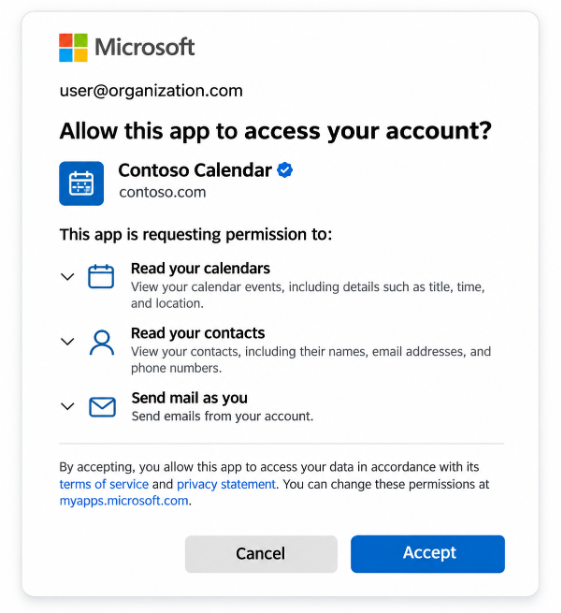
OAuth is an authorization framework. Its permissions, often called scopes, define which cloud resources an application may access and what it may do. A consent screen presents those requests before access is granted.
After approval, the identity provider can issue an access token for API calls. Depending on the flow and scope, the application may also receive a refresh token that can obtain new access tokens. The user or administrator decides whether the application enters that path.
Two permission models matter during an investigation:
- Delegated permissions let an application act for a signed-in user, within the granted scope and the user's privileges.
- Application permissions let a service act without a signed-in user. In Microsoft Entra, they require administrator consent and can be broader.
How attackers gain OAuth authorization
Consent phishing is not the only path, even if it is common. Account compromise can also lead to illicit grants. An attacker who controls an administrator may register an application, approve tenant-wide permissions, or add credentials to an existing registration.
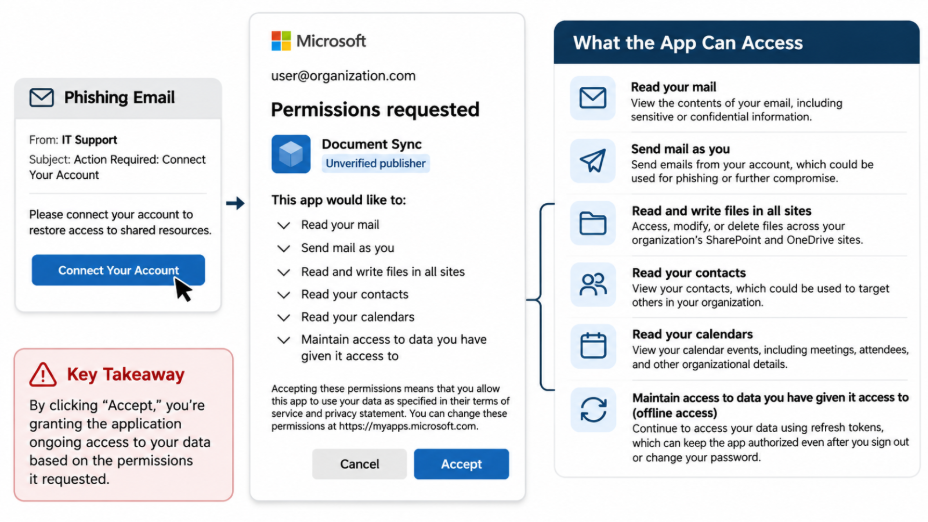
A typical consent-phishing sequence looks like this:
- The attacker creates or controls an OAuth application and requests useful permissions.
- A lure sends the victim to the identity provider's genuine consent page.
- The user authenticates normally, reviews the request, and selects Accept.
- The application redeems the authorization for tokens and begins calling permitted cloud APIs.
OAuth consent abuse compared with credential phishing
Why OAuth access can survive a password reset
OAuth access is tied to an application grant and its tokens, not only to the user's password. Resetting the password may secure the credentials without revoking consent. MFA can also work as designed while the user approves a malicious request after authenticating.
Response must address the application, grants, service principal, and tokens. Disabling a malicious application can stop new tokens, but issued access tokens may remain usable until expiry. Investigate the full access period.
What attackers can do depends on the granted scope
OAuth authorization is not automatically a full account compromise. Impact depends on the scopes, whether consent covers one user or the tenant, and the consenting identity's privileges. Access to mail, files, contacts, calendars, or offline tokens can support data theft, internal phishing, or reconnaissance.
Even routine-looking permissions can carry risk. Evaluate whether requested access matches the application's purpose rather than trusting its name, logo, or consent-page domain.
Possible indicators of OAuth abuse
- Newly registered or newly consented applications without a known business owner
- Unverified or unfamiliar publishers requesting mail, file, directory, or offline access
- Unexpected user or administrator consent events
- New service principals, app credentials, or enterprise applications
- API activity that does not match the user's or application's normal behavior
- Application access continuing after a password reset or account recovery
How organizations can reduce OAuth risk
Limit who can grant consent
Allow users to approve only low-risk permissions from applications meeting defined criteria. Route sensitive requests through administrator approval and verify the publisher, owner, business need, and scopes. MFA still reduces the chance that stolen credentials can register or approve an application.
Apply least privilege to applications
Grant only required scopes. Inventory application owners, credentials, service principals, assignments, and consent grants. Remove unused applications and revalidate high-impact permissions.
Monitor consent and API activity
Collect logs for consent events, registrations, credential changes, and service-principal activity. Baseline expected API behavior and investigate anomalous mail, file, or sending activity.
When a malicious OAuth application is identified:
- Disable the application and prevent further consent where supported.
- Revoke delegated grants, application permissions, related tokens, and active sessions.
- Remove malicious service-principal credentials or assignments after preserving evidence.
- Review audit and API activity to determine which resources were accessed or changed.
- Reset credentials and investigate the user or administrator account if compromise is also suspected.
How ThreatLocker complements OAuth security
OAuth consent governance belongs in the identity platform. Endpoint or network controls cannot revoke cloud permissions, but they can reduce adjacent access paths. ThreatLocker Zero Trust Cloud Access checks the device and pathway before designated cloud services are reached, limiting token replay from unapproved infrastructure.
This device boundary complements consent policies, least privilege, token revocation, and API monitoring. A valid identity or token should not be enough; access should match the approved device, pathway, application, and action.
Treat application authorization as access
OAuth is essential to cloud integration. The risk is unmanaged or malicious authorization.
Know which applications can act for users or the tenant, understand their permissions, and remove access that is no longer required. Ask not only who knows the password, but which applications have been authorized to act.
Frequently asked questions
What is OAuth consent phishing?
OAuth consent phishing convinces a user or administrator to grant a malicious application cloud access. Because the consent page may be legitimate, evaluate the application and permissions, not just the domain.
Can MFA stop OAuth consent abuse?
MFA can block account compromise, but it does not stop an authenticated user from approving a malicious application. Consent restrictions and application review are separate controls.
Does changing a password revoke OAuth access?
Not necessarily. Password changes do not automatically remove application consent. Review and revoke relevant grants, tokens, sessions, service principals, and app-role assignments.
What is the difference between delegated and application permissions?
Delegated permissions let an application act for a signed-in user. Application permissions let an application act independently, such as a background service, and typically require administrator consent.
What should teams do first after finding a malicious OAuth application?
Disable the application, preserve evidence, and determine its permissions and activity. Revoke grants and tokens, investigate affected resources, and reset credentials when account compromise is suspected.

ABOUT THE AUTHOR
Kenneth spent 10 years as a digital creator, developing a strong foundation in digital storytelling and technology before earning his degree in Cyber Operations. His creative background shaped his ability to think outside the box, recognize patterns, approach complex problems from different perspectives, and explore unconventional solutions. He began his cybersecurity career as a Security Analyst, earning Lv. 2 status before transitioning into Threat Intel research. He believes creativity and analytical thinking go hand in hand in cybersecurity, where curiosity, research, and the ability to think like an adversary can provide valuable insight into identifying and understanding emerging threats.